Quick answer: Neurological physiotherapy helps people with conditions of the brain, spinal cord and nerves — such as stroke, Parkinson's disease, multiple sclerosis and spinal cord injury — to regain movement, balance and independence through task-based practice, specialised techniques like NDT and PNF, and family training.
After a stroke or a neurological diagnosis, families in Goa often ask the same questions: will they walk again, how long will it take, and where should we go for physiotherapy? This guide explains what neurological physiotherapy involves and what to look for.
Conditions treated
- Stroke (paralysis or weakness of one side)
- Head injury and traumatic brain injury
- Spinal cord injury
- Parkinson’s disease
- Multiple sclerosis
- Bell’s palsy and peripheral nerve injuries
Why early and regular therapy matters after a stroke
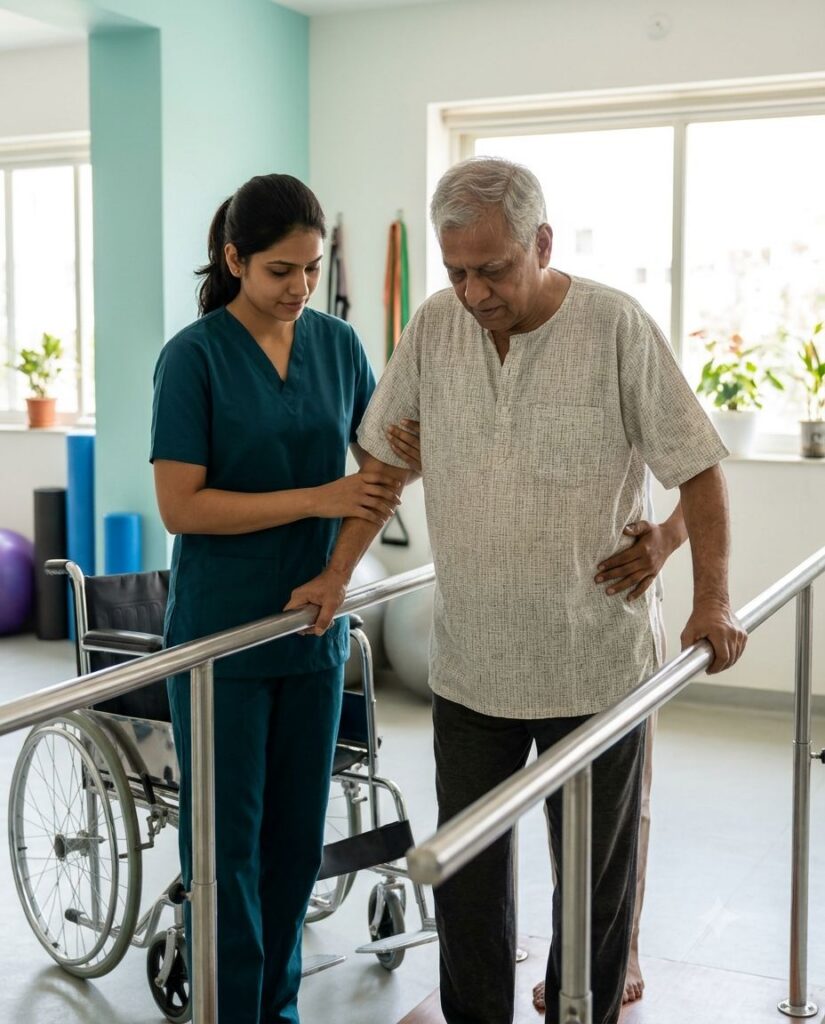
The brain is most able to reorganise in the weeks and months after a stroke, so rehabilitation usually starts as soon as the person is medically stable and continues as an outpatient. Improvement can continue long after the first months with the right practice, but regular, focused sessions early on make a real difference.
What stroke rehabilitation includes
| Goal | Typical approach |
|---|---|
| Sitting and standing balance | Trunk control work, weight shifting, safe transfers |
| Walking | Gait training, strengthening, walking aids when needed, aquatic therapy |
| Arm and hand use | Task practice, PNF, constraint-induced movement therapy (CIMT) where suitable |
| Muscle tone and spasticity | NDT (Bobath) handling, positioning and stretching |
| Independence at home | Family and carer training, home exercise programme |
Techniques you may hear about
- NDT / Bobath — hands-on handling to improve quality of movement and posture.
- PNF — patterns of movement that build strength and coordination.
- CIMT — encouraging use of the weaker arm for selected patients.
- Aquatic therapy — water supports the body so standing and stepping can be practised earlier.
Dr. Michelle D’Souza (PT) is certified in NDT Adult Neuro (NDTA, USA), PNF (IPNFA) and CIMT, and our clinic has an indoor therapy pool.
How to choose the best neurological physiotherapy in Goa
- Ask about specific neuro training (NDT, PNF, CIMT) and experience with your condition.
- Look for one-to-one sessions with a consistent physiotherapist.
- Expect measurable goals (for example walking to the bathroom independently) reviewed regularly.
- Make sure family members are taught how to help safely at home.
Signs of a stroke: act fast
Face drooping, arm weakness or slurred speech — call 108 immediately. Physiotherapy comes after emergency treatment, never instead of it.
Learn more on our neurological physiotherapy page.
Frequently asked questions
How soon after a stroke should physiotherapy start?
As soon as the doctors say the person is medically stable, often while still in hospital, then continuing as an outpatient.
Can someone still improve years after a stroke?
Many people continue to make gains with regular, targeted practice, though progress is usually faster in the early months.
Does Parkinson's disease benefit from physiotherapy?
Yes. Physiotherapy can help with walking, balance, posture and reducing fall risk, and is usually continued over time.
Can family members attend sessions?
Yes, and we encourage it. Carers learn how to help with exercises and safe movement at home.
Want an assessment? Trinity Physiocare & Aquacure is at Evergreen Apartments, G-1, St. Inez, Panaji. No referral is needed. Book an appointment or call/WhatsApp 97656 34278.
This article is general information, not a diagnosis. If you have sudden weakness, numbness, chest pain, loss of bladder or bowel control, or a serious injury, call 108 or go to the nearest emergency department.