Our services
Dry Needling
Fine needles to ease muscle tightness and trigger points
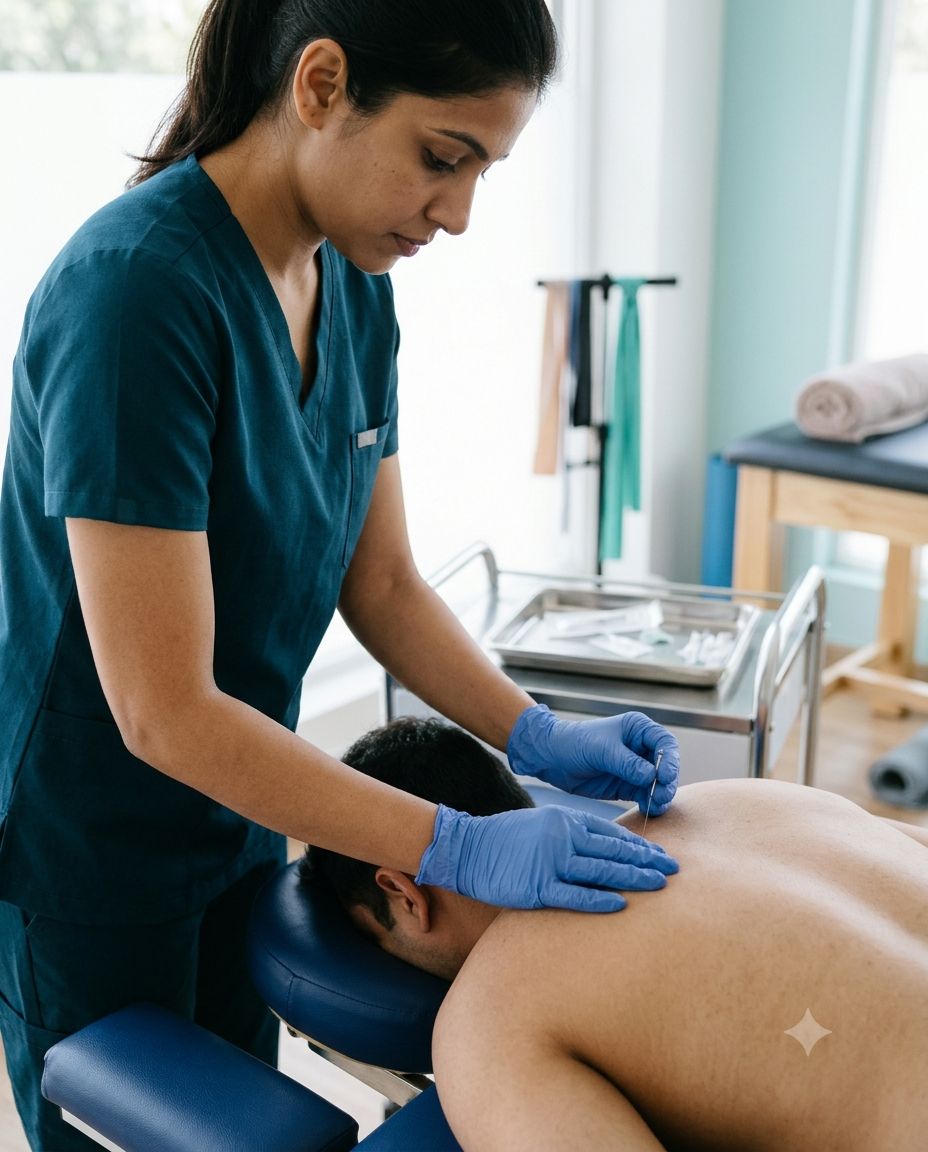
Dry needling uses very fine, sterile, single-use needles inserted into tight muscle and trigger points to reduce pain and help muscles relax.
At Trinity it is used by a physiotherapist as one part of a plan that includes exercise and hands-on treatment.
- No referral needed
- Open Monday to Saturday
- St. Inez, Panaji
It can help with
- Neck and shoulder tightness
- Low back pain
- Tennis and golfer’s elbow
- Muscle knots and trigger points
- Sports muscle strains
- Tension-type headaches
How we use dry needling
Assessment first
We check whether dry needling suits you and your problem.
Targeted needling
Sterile, single-use needles placed in specific tight muscles.
Manual therapy
Combined with hands-on techniques where helpful.
Exercise
Movement and strengthening so the benefit lasts.
What to expect
You may feel a brief prick and sometimes a twitch or ache in the muscle. Mild soreness for a day or two is common. Dry needling is not suitable for everyone, for example people with a needle phobia, bleeding disorders, some infections or in certain stages of pregnancy, so we always screen you first and ask for your consent.
Dry needling is not the same as acupuncture: it is based on anatomy and muscle assessment and is used within physiotherapy.
Questions about dry needling
Does dry needling hurt?
Most people feel a brief prick and sometimes a muscle twitch or deep ache. Mild soreness afterwards usually settles within a day or two.
Is dry needling the same as acupuncture?
No. Both use fine needles, but dry needling targets specific muscles found on assessment and is used as part of physiotherapy treatment.
How many sessions will I need?
It varies. Dry needling is usually used for a few sessions alongside exercise, not on its own.
Other services
Aquatic Therapy
Exercise in warm water, with less load on painful joints.
Orthopaedic Physiotherapy
Joint, muscle and bone problems, injuries and recovery after surgery.
Neurological Physiotherapy
Stroke, Parkinson's, MS, nerve and spinal cord conditions.
Spine Care
Back and neck pain, sciatica and posture-related problems.
Sports Physiotherapy
Injury care, taping and a safe return to your sport.
Paediatric Physiotherapy
Play-based therapy for children with developmental conditions.
Manual Therapy
Hands-on treatment for stiff joints, back and neck pain.
Ready to start?
Book an assessment, or call us to ask whether physiotherapy can help with your problem.
Visit usEvergreen Apartments, G-1, St. Inez, Panaji · Directions
Opening hoursMon–Fri 9:30–1:30 & 3:00–7:00
Sat 9:30–1:30 & 3:00–5:00
Call or WhatsApp+91 97656 34278